

For decades, the debate over what makes us distinct as a species has oscillated between philosophy and biology. Today, a growing body of scientific evidence suggests the answer may be deeper — and older — than we imagined.
Based on what the data from science is telling us, from researchers like Suddendorf and others, there is now a real effort to understand what it is that gives us these capabilities. What is it that makes us different in kind? The consensus that appears to be emerging is that there’s a combination of four qualities we possess as human beings that give us these unique capabilities.
The first is symbolism. We as human beings can represent the world with symbols, and we can even represent abstract ideas with symbols. We can then go one step further and combine and recombine them in all kinds of different ways. In doing so, we can create narratives, and this is the basis for language, music, and art.
In addition to that, we have theory of mind, where we recognize that others have minds like ours. We know what they’re thinking, we know what they’re feeling. And then we have this compulsion to integrate our minds together, to collaborate with other minds like ours. This leads to the ability to create very complex social, hierarchical structures in which we organize other minds in relationship to ours. It’s this combination of qualities, expressed to a high degree, that essentially makes us unique and exceptional as human beings.
Now, if you adopt a structuralist view or a resemblance view for the image of God, you could argue that these qualities are simply scientific descriptors of what we would understand to be the image of God. By recognizing that there is an emerging scientific case for human exceptionalism, and understanding what qualities make us exceptional, we can link that to the image of God concept and make a case that, as we increasingly show that humans are exceptional, we can marshal that evidence to demonstrate that what Scripture teaches about our nature and identity is scientifically credible.
What About Neanderthals?
This naturally leads to the question: were Neanderthals like us or not? Even though it is commonplace today among many anthropologists to argue that Neanderthals were like us, when we begin to probe the scientific data more thoroughly, we recognize there are actually some fundamental differences that lead us to conclude that Neanderthals were not like us.
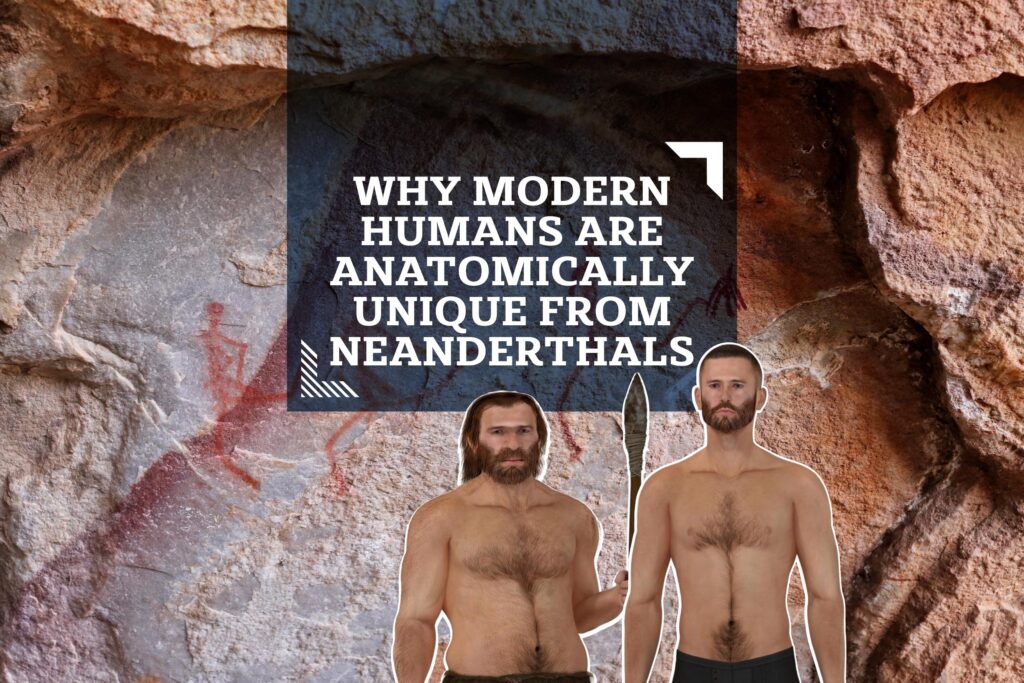
For example, human beings have a rather unusual skull anatomy. We stand apart from all other creatures in our anatomical features; we have a globe-shaped skull and a flat face. Neanderthals, on the other hand, have an elongated skull and a face that juts outward. This is profound in terms of brain structure, because it leads to an expansion of the parietal and temporal lobes, which give us the capabilities that make our exceptional activities possible.
What’s interesting is that when you look at virtual endocasts of hominins like Homo erectus, Homo heidelbergensis, and Neanderthals, it’s essentially the identical brain structure; Neanderthals simply have a larger version of it. Humans, on the other hand, are outliers in terms of our globular skull, and this allows for a number of different capabilities that are pronounced in us compared to Neanderthals.
When Does the Globular Skull Appear?
The globular skull shape seems to appear about 130,000 years ago, and this is also about the time we actually see evidence in the archaeological record for symbolic activity. Language won’t be preserved in the archaeological record, but art will be, and symbolic artifacts will be, and so these are taken as proxies for human language and symbolism.
It used to be thought that the very first appearance of art in the archaeological record was just shy of 40,000 years ago, in the cave systems of Europe. But in recent years, there have been a series of discoveries of cave art in Southeast Asia that is qualitatively identical to the art found in European caves, and actually older. This means that when humans began to migrate around the world, this capability for art already existed in us.
As anthropologist Christopher Stringer writes, this is really important: it enables us to get away from the Eurocentric view of a creative explosion that was special to Europe and did not develop elsewhere until much later. The basis for this art was there 60,000 years ago, and it may have even been there in Africa before that, and it spread with modern humans.
There has also been discovery of evidence for symbolic activity in the coastal caves of South Africa going back roughly 50,000 to 80,000 years ago. And Miyagawa, a paleolinguist at MIT, argues that rock art produced by the San, considered among the oldest people groups on the planet, is identical in character to the art in the caves of Europe. The San break away from the main human lineage at about 120,000 years ago, which means this capacity for art was present very close to the time when the globular skull emerges.
This is scientifically satisfying because we see a confluence of evidence: the archaeological record and the anatomical details of modern humans are in line with the idea that we are indeed exceptional.
By: Fazale Rana
——————————
Visit https://ses.edu to learn more about our programs and courses.
Support a seminary that integrates philosophy, theology, and apologetics into one unified worldview. Give at: ses.edu/give
Follow us on social media:
- YouTube: https://www.youtube.com/@SouthernEvangelicalSeminary
- Facebook: https://www.facebook.com/sesapologetics
- X: https://x.com/sesapologetics
- Instagram: https://www.instagram.com/sesapologetics/
- LinkedIn: https://www.linkedin.com/school/sesapologetics/
- TikTok: https://www.tiktok.com/sesapologetics/
This article is based on a video transcript and does not necessarily reflect the official positions of SES. To watch the full video, click here: https://youtu.be/eD5r6wxUIDc